Friday, December 10, 2010

07 December - Humpday!

Today is the midpoint of our cruise (otherwise known as Humpday). Unfortunately, not a lot has been happening over the past 48 hours as the weather has been very uncooperative for doing much of our science.  We've had sustained winds of 25-30 kts for the past 36 - 48 hours, so that has meant we've been unable to do our CTD casts or net tows because of the sea state. We don't carry spares for those pieces of equipment so we are pretty cautious about deploying that gear in questionable conditions. We've also run out of live animals in our aquaria for our experiments so the field team has been spending today trying to catch up on entering data into the computer from our paper records.

The other science party on this trip has been able to commence some of their research. They are studying penguin colonies on the South Sandwich Islands so they have been able to launch a zodiac and zip over to land to count nests and see how populations at some of these locations are (or are not) changing over time. We'll try to get a guest blog post from them in the next few days but right now they're spending most of their time on the ship trying to warm up (as outside temperatures have stayed at around -20 oC all day today).

We've gotten a couple of questions from school kids that we'll be posting our answers to over the next few days, however if anyone has any questions for us, please post them in the "comments" section of this blog post. In a few days, my land-based team member (Hi Melissa!) will collect them all and send them  to us on the ship so we can answer them in a future blog post.

And as requested by Dr. Gareth Lawson from WHOI, here's a photo of some of our experiments (before we ran out of animals):


Katie (left) and Melissa (right) are measuring the density of some salps relative to the surrounding seawater. They do this by titrating solutions of higher and lower density into a container with a salp in it and determine at what point the salp is neutrally buoyant.  The difference between the density of the animal and that of the seawater affects how much sound a zooplankton will scatter.

We measure the soundspeed of animals (in this case small salps) by placing them in a chamber with a transducer (speaker) on one end and a receiver (microphone) on the other. Using a computer, an oscilloscope, and some other equipment, we can figure out how fast sound travels through the animals. This has an important effect on how much sound the animals scatter.

Post your questions in the comments section !
-Joe

Tuesday, December 7, 2010

06 December - Salp Poetry Special

It appears that Salp-Fever is sweeping the hallways and decks of the L.M. Gould.  We've been catching salps regularly in our net tows and several people in the field team are now members of the prestigious Southern Ocean Salp Sucker Society!  Even the Marine Techs have become enchanted with our gelatinous zooplankton friends.  So, I present two poems about salps written by two of our great MTs (Ode to the Salp by Mereidi Liebner and the slightly darker "death to salps, an anthem" by Chance Miller). For the record, Chance's poem does not accurately describe our experiments. Poets often use artistic license to illustrate a point and that is the case here. Warning: Some poems may contain adult language and/or themes.

A Grand Salp Adventure by Mereidi Liebner

There once was a Salp named Sylvester.
He lived in the sea with his girlfriend ester.
He thought she was boring, and went out exploring
And soon found that he did not need her.

He swam eating and growing,
He made babies behind, unknowing.
That fate would soon twist,
Carbon making desist,
And all that he knew would stop flowing.

A noise, and a swish surrounded,
He never was, nor not quite ever grounded,
Enough to foresee this new theme in the sea
Studies that more have astounded!

So feeble and yet quite forlorn,
The net got him, the vice of Joe Warren.
To be studied by Kate,
there be no more free mate,
He should have just kept being boring.


death to salps, an anthem by Chance Miller

those salps know what they done was wrong
we know those bastards don't got long
we'll catch them with this song
I think we'll catch them with this song
salty protean slippery salps
We'll kill them with our net
and watch scientists drown them in medicine
numbing wounds they won't forget.
these wounds they won't forget.
those salps... salacious, portentous,
boiling in alka seltzer while we grin,
We'll watch them sink to the bottom,
and float them back again.
In the end when we are done
and they've been sent through hell,
tortured in the name of science, 
for sins we can't re-tell
they'll find solace in their turmoil
in a negative eighty cell.

-Joe

05 Dec - Southern Ocean Salp Suckers Society Induction Ceremony

It’s going on 2 weeks into the cruise now and each day is melding into the others. I no longer know what day of the week it is or what happened on any particular day without sitting and thinking for a few minutes. HOWEVER! Today is a notable one. Notably good!


First, I awoke this morning to learn that Joe has decreased our workload, w00t! Mostly, we’re not counting and measuring as many zooplankton. We still working or on-call 16 hour shifts total, but our on watch hours are significantly easier, leaving much more down time during the latter half of our shifts and potentially more time for sleeping (although I’ve yet to experience that because for some reason we seem to hit every station while I’m on).
Second, pizza for dinner.

Third, I found a strange Spanish Nestle chocolate flavored powdered energy drink behind the hot chocolate mix, which I added to my hot chocolate. It was quite tasty. And apparently very effective. I was on vibrate mode for a few hours.

Fourth, and finally, at the end of the day (well, the end of my day which ends at 4 in the morning when I get off shift) we hit the salp motherload. Buckets of salps! With the abundance of the gelatinous plankton, Joe made an executive decision. It was time for the LMG1010 first meeting of the Southern Ocean Salp Suckers Society! Karen and I were the new inductees as Katie was off shift and in bed. Induction into SOSSS is very simple and requires only one thing: you must eat a salp. Joe handed us each a salp from one of our buckets, took one for himself, and then it was down the hatch. It was a unique experience. The salp slid down my throat in one salty swoop, no chewing required. Not so bad! Not as good as, say, pizza or cookies but probably better than eating a krill, so I’m not complaining.

Melissa enjoys a snack between meals on the L.M. Gould.


-Melissa

4 Dec 2010 - What IS a Salp???


You are probably wondering,….what are those scientists so riled up about down there! What IS a salp? Let me tell you: salps are awesome!!!

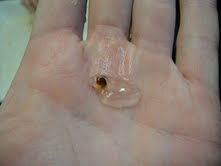
A typical salp.

So they may not look like much, but if you dive a little deeper into their natural history, you will become intrigued. First of all, while they appear to be just a small lump of gelatin, salps are indeed animals! They can swim (slowly) by propelling water through their bodies and are constantly feeding (just like I wish I could be…). They eat by creating a mucus net, allowing it catch food particles floating by, and then ingest the net full of particles!! Genius. They will eat pretty much anything entrapped in their net if it is between 1µm to 1mm in size. The red / orange blob is their coiled intestine.

Here are some salps we recently caught in a net tow.

You probably are wondering, what eats these guys? Lots of things do! Certain fish, amphipods, krill, and some other zooplankton may chow down on a salp if they find one. Delicious!

Another reason why salps are both awesome and related to your life back at home is their impact on the global carbon cycle. Because they consume food quickly and there are so many salps in the oceans – they have a significant role in the vertical carbon flux. Downward carbon flux, such as towards to the sea floor, is great because it removes carbon from the upper ocean which in turn removes atmospheric carbon dioxide. Salps do this by producing large (1 to 10mm long) fecal pellets chock full of carbon. The pellets are denser than sea water and rapidly descend into the depths.

Salps also have a very interesting sex life. They are found in both solitary / individual form (alone) or in an aggregate / chain group. The solitary forms reproduce asexually, which means the “babies” are clones of themselves. The offspring are produced in a chain which can be hundreds of salps long! They are released from the parent in chain form; this is known as an aggregate group. The group of young salps work together to swim and feed, and the chain grows. Each individual is known as a blastozooid. Some of the blastozooids will reproduce sexually; and a new baby salp (embryo) will grow attached to the body of the parent. Eventually, this baby is released in the solitary form, and will grow and reproduce asexually, bringing everything full circle. Can you imagine if we grew like that?

Because of this remarkable reproduction cycle, salps can grow very quickly!! One generation can be as short as 50 hours.

Scientists believe that salps have one of the first occurrences of a primitive nervous system. More complex nervous systems, such as ours, likely evolved from salps! That’s awesome!

Remember, a salp in the hand is worth two in the sea!!

Stay tuned to learn more about our Salp studies!

Signing off,

Katie.

04 Dec 2010 - Seamounts and Salps


It was around 5 in the morning. Katie and I were performing titrations with sea water of different salinities in order to find the densities of individual salps, and I happened to look outside. It was the first crystal clear sunny day in a while and there were hundreds of birds swooping down to the water. A dozen or so penguins broke the surface of the water, porpoising. Porpoising is when penguins leap out of the water while swimming, making them look like they’re pretending to be porpoises. Katie and I ran up to the 01 deck (above the main deck where we work) to see the feeding frenzy. A couple of whales spouted. The boat steamed steadily along, and we realized that we and the people on the bridge (where you steer the boat) were probably the only ones who had seen this. The pictures I took did not adequately represent the explosion of life that we witnessed on that cold crisp sunny morning.

When we returned to the lab, the ADCP (Acoustic Doppler Current Profiler; also shows bottom contour) showed that we had just passed over a sea mount. 

A seamount as seen on the ADCP computer. 

Sea mounts are underwater features that are typically associated with high levels of biological productivity. This is often due to the upwelling of nutrient-rich deep waters that they cause.

- Karen

Saturday, December 4, 2010

November 30th: Science!

We left Palmer Station around noon today, heading for our first sampling station, but because of an apparently massive low pressure system sitting over the Drake, we had to veer a bit off course to a more sheltered area where we wouldn’t be beaten to a pulp. We rerouted to a different station to work out the kinks in our sampling methods. The work started almost immediately that afternoon with the first of many CTD’s and net tows to come. Katie and I were on shift and were a little bit frazzled once we realized that we didn’t really have much of any idea of what we were doing! We didn’t catch too much in the net, but if you ask me, it was a decent first catch – small enough that our heads didn’t explode at the thought of sorting, identifying, and counting them all, but comprised of most of the common species that we will be seeing in the majority of our tows.


We’re working ~12 hour shifts, which means (at least for Karen and I who work the night shift) that we get to watch the sun set and then rise again a few hours later! The first day of science had an especially pretty sunset and the sunrise was just as good with ice in the background being illuminated by the sun. 

The field team on the backdeck of LM Gould looking extremely serious for some reason (from left to right: Katie, Karen, and Melissa).
Getting ready to dissect Wolfie (the Stony Brook University mascot) in the wet lab.


- Melissa

03 Dec – One week down...


We left Punta Arenas on Thanksgiving Day, but have only been doing our science stations for the past 3 days. Things are going fairly well so far; we're catching zooplankton (salps and krill primarily) in our net tows which is great as we've got animals to do our experiments onboard the ship. However, we have had to skip (or move the location) a few of our planned stations. As we headed towards one station last night, the Captain came down and suggested that I may want to consider moving our station location a bit south (towards the north side of King George Island) as he was starting to see swells that were ~ 28 ft high. So we did that and it's worked out pretty well.

Alarm --- fire drill time!

OK, back from the fire drill. Roughly once a week, the ship will ring the alarm bells unannounced and while the crew goes to their prepared stations and duties (depending on which alarm bell signal was heard), the scientists all muster in the lounge. You have to bring your life jacket and survival suit (and it's a good idea to bring a jacket and hat as well) and we take attendance and make sure the science party is accounted for. Sometimes, if there is a super-great chief scientist onboard, he'll even bring a chocolate bar that gets passed around!

Now that the drill is over, it's back to the science. We haven't really talked about what we're doing on this trip so I'll try to explain that now. In the Antarctic ecosystem, krill are the primary food source for all of the larger animals that exist down here (like whales, seals, penguins, and other sea birds). Unlike other oceanic ecosystems which have many different types of animals, almost all the energy in the Antarctic food web passes through krill at some point.

Antarctic krill, Euphausia superba, are crustaceans that can live up to 7 years and as adults are around 5 cm (2 inches) in length.

In some places or times in Antarctica, you can find very high abundances of another zooplankton, namely the salp (Salpa thompsonii). These animals are gelatinouus (sort of like jellyfish) and are mostly transparent in the water except for their gut which is usually a dark red or brown color. Salps often occur in long chains of animals all connected to each other, or sometimes you'll find solitary (and larger) salps as well. Salps and krill are believed to be in competition for phytoplankton resources (i.e. they compete for the same food) and in some years you find lots of krill and in other years you find lots of salps. The salps are less nutritionally valuable to predators so if you have lots of salps and less krill, that may have a negative impact on the birds and mammals that feed on krill. One hypothesis is that as the climate changes (and the Antarctic peninsula is warming at a much more rapid rate than the earth as a whole), we may see decreases in how much sea ice forms each winter which is believed to be a better environment or conditions for salps than for krill. So some people think we may be seeing a shift in the abundance of salps down here.

Salps are kept in a cold room in aerated aquaria. In this tow, we caught lots of small (1 cm length) salps but also a couple of very large salps (~ 10 cm in length). Amazingly some of the salps were still in their chain form despite being brought up in the IKMT net!

In order to measure how many salps or krill there are in any area, you have to count the animals in the ocean. If you use a net to capture these animals, it can be difficult to count how many salps there were as they are very fragile and can get destroyed by the net tow collection process. We're doing fairly shallow and short net tows so the animals that we bring up are in good shape for our experiments.

One of our goals on this trip is to assess the utility of using acoustic echosounders (which are scientific instruments similar to fish finders you see on most boats) to measure the presence or abundance of salps. Since we're sending out acoustic waves, we don't damage the animals in the process and we can cover a lot more area using a boat with an echosounder than if we are only using net tows. We can use acoustics to survey krill fairly well in this environment, but we'd like to be able to do the same thing for salps. In addition to collecting acoustic data during our survey, we're measuring various properties (size, shape, animal body properties) of the salps we catch to see if we can use that information to better interpret our acoustic survey data. It's a pretty complicated process, but the overall goal of our project is to improve our ability to remotely measure the abundance of salps in this region and then to see if there are changes in salp abundance either spatially, over time, or correlated with other environmental parameters. And if we can measure how many salps there are and if that's changing in space or time, then that can give us insight into how the presence of salps might affect the Antarctic ecosystem and the larger animals that live in these waters.

This is not one of the normal krill predators you would find in Antarctica. For the record, krill don't really taste like anything, mostly salt-water. They are full of omega-3 compounds so you can find Krill Oil dietary supplements in many health food stores next to the fish oil section.

We'll try to provide some more pictures of the actual experiments in the next couple of days. We're just excited to have lots of animals onboard the boat so we can do our projects.

-Joe